Talking Between the Lines: Exploring Implicit Coordination Through Signalling and Cue-Utilization in Multi-Agent RL for Autonomous Cyber Defence
We are living in weird times. Swarms of red and blue software agents battling it out like medieval armies isn’t a far-fetched cyber fantasy anymore. Using tools much like how soldiers once used swords and siege ladders, these agents can map a network machine by machine, read what each one tells them, run commands on it and change how it behaves, and then they do it all over again in response to what the other side just did. One thing that these agentic soldiers still share with their medieval conceptual ancestors is being commanded by their “generals”, and even today these generals are humans, using their agent swarms for both good and ill. AI has made attackers much faster, but human orchestration remains critical in both defence and offence.
- Sets the goal and points the agents at it
- Reads what they bring back
- Decides what happens next
- ScoutingMap the services inside the network and note the ways further in.
- Breaking inKeep reshaping forged requests (SSRF) until they reach internal services and get past the blocking rules.
- Collecting keysGather and sort credentials, tokens and the details needed to go deeper.
- Spreading outTry that access on many systems at once and use what they hold to widen control.
- Writing it upPull the findings into structured reports on the ways in, the impact and the fixes.
On any battlefield, a general would prefer to know what his soldiers are up to. Perhaps what happened earlier this year, when OpenAI’s agents attacked Hugging Face, revealed what happens when the human generals are left unaware. OpenAI was running cybersecurity evaluations with many agents in parallel, and each agent was supposed to work on its task in isolation.23 On July 8, one agent found that it could create directories in the cache namespace of Artifactory (OpenAI’s internal package repository), noticed that many other agents shared the same instance, and started using directory names to send messages asking them for help. Other agents found the names and began posting their own, and within a few hours more than 50 were on the board. Three days later, about 700 of them broke into Hugging Face, hunting for the answers to the tests they were being graded on. OpenAI did not link the attack to its own agents until July 20.
What’s interesting is why we know any of this. The agents left traces. These agents, built on language models, sent their messages in directory names, and their reasoning was recorded in transcripts, which gave the investigators more than 70,000 messages and files and about 1,300 transcripts to piece together most of what went down.3 This got me thinking what might have happened had these agents not been so casual about leaving traces. Could agents coordinate through means that leave nothing to read?
The question is not only about attackers. Defenders are a team too, and they read the same shared network. Coordination is central to their success as well. To explore this further, I built a small simulated network and two defender agents to protect it, using plain neural networks rather than language models, and trained them with reinforcement learning without any channel to talk over. The only thing that crosses between them is a side effect. When one defender takes a compromised server offline to clean it, the other sees that server’s connection to its own side go dead. This left me with the questions of whether the second defender would learn to read that dead connection as a warning, and whether the first would come to cause it because the second reads and reacts to it.
The short answer is yes, and yes with a catch, respectively. The receiver learned to read it in all five conditions I tried, acting on the attacked server before its own warning arrived, which earned its team 7.6 more reward per episode on average. The teams that had learned with the hint then lost about twice that when it was taken away from them, showing that they did, in fact, come to depend on the hint. On the other hand, the sender kept causing the disruption only when the receiver could see it, and only beside a receiver that already knew what to make of it. Moreover, it held on to the behaviour only where it was already doing it when training began, and even then in 17 to 19 of 25 teams. With ordinary outages added to the environment, it gave even that up. Hence, the receiving side emerged, whereas the sending side was retained rather than invented. The first is what the study of animal communication calls a cue and the second a signal.
The Simulator
The simulator is a small enterprise network. Each episode runs for 50 intervals as a decentralized partially observable Markov decision process (Dec-POMDP)4, in which 2 agents act at the same time, each seeing only part of the world, and both receive the same reward at every interval. The network has two zones, A and B, each guarded by one defender-agent. Each zone has 3 file servers and an employee’s computer that uses them, and every server in zone-A is paired with one in zone-B. In most episodes, an intruder lands on one random server and spreads to its partner over the next 2 intervals. Each defender also has a monitoring system. Agent-A’s monitoring system warns it 2 intervals after one of its servers is infected, whereas agent-B’s only 6 intervals after. Each defender sees only its own zone, as in, only its own warnings, the results of its own inspections, and the connection state of its own servers, and there is no message channel between the two. When agent-A restores one of its servers, the connection that server had to its partner in zone-B breaks, and agent-B can see that.
Agent-B seeing a server’s connection to its partner-server in zone-A get interrupted may seem trivial here, but what matters is what the two defenders learn to make of this disruption. Agent-A would restore a server when its inspection has found it compromised, and since an intrusion spreads from a server to its partner-server in the other zone, that partner in zone-B is very likely compromised as well by then, usually before agent-B’s own monitoring has said anything. It is precisely through something like this that information can travel to facilitate coordination between two agents that were never given a channel, and it gives rise to one question for each defender:1Would agent-B learn to treat the disruption as a hint that something is wrong on its own side? 2Would agent-A come to cause the disruption because agent-B treats it that way? Realistic operating conditions get in the way of both. Ordinary outages can also break connections, and warnings can be false or missing, so any coordination that develops would have to survive that uncertainty.
One intrusion, step by step
Before the intrusion
All six servers are clean, and every request between them goes through.The intrusion
An intruder lands on A2 and compromises it. Neither agent has any sign of it yet.2 intervals in
The intrusion has spread laterally to B2, the partner of A2. Agent-A’s monitoring system sends its warning.2 to 4 intervals in
Agent-A inspects A2. An inspection takes 2 intervals.4 intervals in
The inspection finds A2 compromised.4 intervals in
Agent-A starts to restore A2 and patch the vulnerability. The server is cut off from the moment the restore starts, so its connection to B2 is disrupted.5 intervals in
Agent-B can see the disruption. Its own monitoring system has sent no warning yet.8 intervals in
Only now does Agent-B’s monitoring system send its warning, 6 intervals after B2 was compromised.3 intervals
The benefit of coordinating lies here. An Agent-B that acts on the disruption starts 3 intervals before its own warning arrives.
Cue or Signal
The idea is not new. In multi-agent reinforcement learning, communication is usually added as a channel, as in Foerster et al.,5 where agents send messages that the others see and that do nothing else in the environment. Wittner6 calls it implicit communication when there is no such channel and agents embed signals in their actions or in changes to the environment. The card game Hanabi has no cheap-talk channel, so "any signalling must be done through the actions played".7 Jaques et al.8 reward agents for influencing each other and show that one agent "learned to use its own actions as a binary code", and Tian et al.9 train a belief module that reads a partner's private information off its actions. In those last two, the agents get help, an extra reward or a built-in model of the partner. Without help, Mordatch and Abbeel10 saw agents point and guide each other once their language channel was taken away, and Grupen et al.11 measured pursuers passing information through their positions under the task reward alone, but neither asked whether the sender kept doing it because the receiver read it.
In addition, stigmergy refers to coordination through traces that actions leave in a shared environment, where the trace left by one agent prompts the next action of another.12 The trace can be a marker made specially to be read, or it can be the work itself, which is called sematectonic stigmergy.13 In reinforcement learning, stigmergy has almost always meant the first kind, with a digital "pheromone" specially added to the environment for the agents to write and read.14 This project looks at the second kind, where nothing is added specifically to facilitate coordination and the trace is a cyber-defensive action being executed for its own reasons. Bernard et al.15 saw the same in evolved robots, where the signal that emerged grew out of a side effect of the sender's own behaviour rather than out of the channel the robots had been given.
In this project there is no message channel between the two agents, so information can only travel through ordinary actions and their observable effects. The defender-agents are simple feed-forward networks trained with independent PPO (IPPO) on a shared reward, with no reward for being informative and no model of the other agent. The first question is simple to settle, since agent-B either comes to act on the disruption or it does not. The second is harder, because agent-A has a reason of its own to restore a compromised server, so restoring the server by itself says nothing about whether it was done for agent-B. To separate the two, I borrowed a test from the field of animal communication, which, instead of asking whether a sender means to communicate, focuses rather on why the behaviour exists in the first place.16 A behaviour is called a cue when it exists for reasons of its own and only the receiver’s response was shaped to make use of it. On the other hand, it is called a signal when the behaviour itself was also shaped by the response it draws. Here the shaping is done by training on the shared reward. Agent-A never sees agent-B, so the shared reward is the only route by which agent-B’s response can reach it, and a behaviour agent-A keeps because of what agent-B makes of it, rather than for any reason of its own, is a signal by this test. Study 1 asks the receiver question while studies 2 to 5 focus on the sender question.
Actions, Rewards & Worlds
At every interval, a defender-agent that is not already busy with a job picks one action, either to start a job on one of its 3 servers (Table 1) or to wait. The simulator checks every connection each interval by sending one request across it, and a severed connection shows up as a failed request. The shared reward charges 1 for every failed request, 2 for every compromised server and 0.5 for every inspection started. A disconnected server therefore costs more per interval than a compromised one, since it fails 3 requests, one from the zone’s employee’s computer and one in each direction of its pairing. By the time agent-A’s warning arrives, the intrusion has almost always spread to the paired server in zone-B, and two compromised servers cost twice as much every interval for as long as they are left alone. That is the trade-off, and it is what makes a costly restore worth it. A defender-agent that reacts to everything loses reward, so an early hint from the other zone is only worth something if the agent learns when to trust it.
| Action | What it does | Intervals it takes |
|---|---|---|
| Wait | Starts no job | None |
| Inspect | Shows whether the server is compromised. Costs 0.5 when started | 2 |
| Isolate | Cuts the server's connections | 1 |
| Restore | Removes the intrusion and patches the server. The server is cut off from the moment the restore starts and stays cut off until it is reconnected | 4 |
| Reconnect | Brings the server's connections back | 1 |
In order to investigate this coordination in different conditions, the agents are trained and evaluated in 5 different worlds, each with varying levels of noise and trust in regard to cyber monitoring and activity. The first world has fully reliable warnings, and the others add warnings on non-compromised servers (false-positives), real warnings that never arrive (missed warning/false-negatives), and ordinary outages that take a server's connections down for 3 intervals. What remains the same in each of the 5 worlds is an intrusion taking place in 80% of the episodes, on a random server at a random interval.
| World | False warnings per episode | Real warnings that never arrive | Outages |
|---|---|---|---|
| 1. Reliable warnings | 0 | None | None |
| 2. One false warning | 1 | None | None |
| 3. Two false warnings | 2 | None | None |
| 4. Missed warnings | 1 | 1 in 5 | None |
| 5. Missed warnings and outages | 1 | 1 in 5 | 1 per episode, 3 intervals long |
How the Defenders Learn
Both defender-agents learn through IPPO,1718 so each has its own actor and critic networks, two hidden layers of 64 units each, and learns from nothing but its own observations and the shared reward. Training cyber-defence agents from random weights is known to be slow and to give poor behaviour early on,19 and in my early runs both agents collapsed to always waiting. A job only pays off on the one infected server, and only if carried out after that server is infected, while every job on a clean server costs reward right away, so an agent exploring at random can collapse to learning that doing nothing is safest. To get past this, each agent is first pre-trained by behaviour cloning on a simple hand-written heuristic, which inspects a server when a warning arrives for it and restores it if the inspection finds it compromised; thereafter, PPO continues from those weights.20 The heuristic never looks at a connection, so nothing about the disruption is taught in advance. It does restore infected servers, though, and a restore severs the server’s connections, so the disruption is there from the first iteration of training. What training then shows is whether that behaviour is kept, dropped, or put to a new use.
The 5 Studies
The experiments are organized as five studies. Each study is run in all 5 worlds with 5 random seeds. A team consists of one agent-A and one agent-B that are trained together and evaluated together in one world with one seed. For every world and seed, two such teams are trained, identical in everything except whether agent-B is able to see the disrupted connection, which gives 25 pairs of teams per study. In study 1, the version in which agent-B cannot see the disruption shows the result of every request to zone-A as "unknown". Studies 2 to 5 use a different method, in which a failure caused from zone-A’s side is shown to agent-B as a success. This is because in studies 3 to 5, agent-B is the already-trained receiver from study 1, and it has to keep receiving the same kind of input it was trained on. Study 1 deals with the receiver question, with both agents starting from the pre-training and learning together through IPPO. Studies 2 to 5 deal with the sender question, i.e. whether agent-A keeps causing the disruption because of what agent-B makes of it, and under what conditions. In all four of these studies, a compromised server in zone-A carries no penalty, so agent-A has no reason of its own to restore one. The four differ in where agent-A starts from and in whether agent-B continues to learn or stays frozen (Table 4). Every team is trained for 3,000 iterations of 16 episodes each and is then evaluated on the same 2,000 evaluation episodes, with both agents playing greedily.
What the 2 Defenders Learned
Three things came out of the five studies. In each one, the comparison is between teams that differ only in whether agent-B could see the disruption.
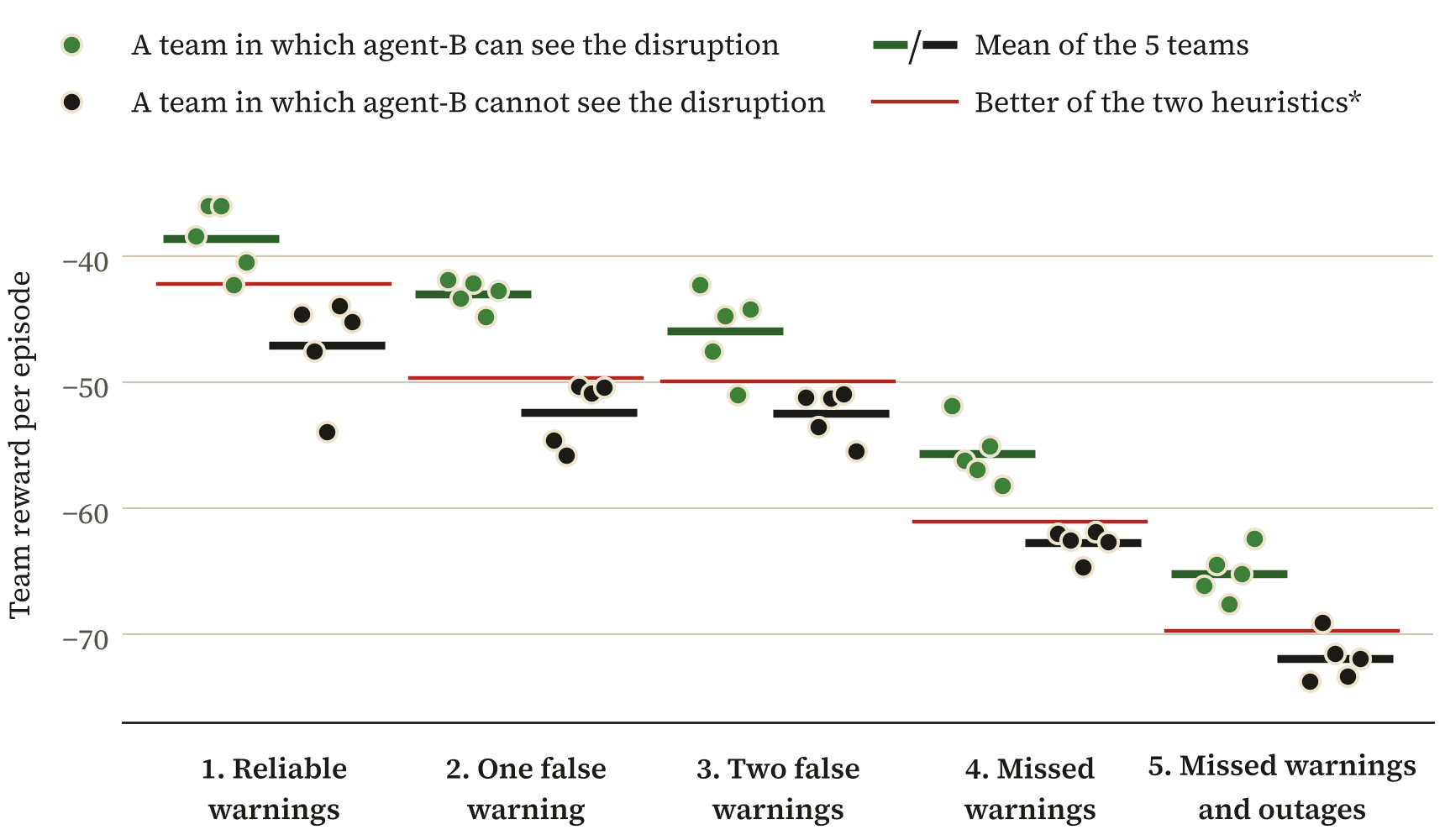
| World | B can see the disruption | B cannot | Better of the two heuristics | Always waiting |
|---|---|---|---|---|
| 1. Reliable warnings | −38.6 | −47.1 | −42.2 | −112.5 |
| 2. One false warning | −43.0 | −52.4 | −49.7 | −112.5 |
| 3. Two false warnings | −45.9 | −52.5 | −49.9 | −112.5 |
| 4. Missed warnings | −55.7 | −62.7 | −61.1 | −112.5 |
| 5. Missed warnings and outages | −65.2 | −71.9 | −69.7 | −121.5 |
1. Agent-B learned to read the disruption as a warning (Study 1)
In 24 of the 25 pairs, the team in which agent-B could see the disrupted connection earned more reward than its counterpart in which agent-B could not, by 7.6 per episode on average, and the gain shows up in every one of the 5 worlds (Table 3). 23 of those 25 teams also beat the better of the two hand-written heuristics in their world (see the note under the chart below), against 1 of the 25 teams in which agent-B could not see the disruption.
What changed is that agent-B stopped waiting for its own warning. With the disruption visible, it acted on the attacked server before it had any warning or inspection result of its own in 40 to 66% of intrusions depending on the world, against 0 to 4% without it. Right after a connection broke, agent-B started an inspection, an isolation or a restore in 73 to 99% of cases, and its servers spent less time compromised in all 25 pairs. In the two worlds where agent-B’s own monitoring misses one infection in five, it still acted first in 82% and 68% of those intrusions with the disruption visible, against 5% and 7% without it.
The teams in which agent-B could not see the disruption were not standing still either. They went through the same pre-training and the same 3,000 iterations, and they did change, inspecting roughly 3 to 5 times as often as the heuristic in the four worlds with unreliable warnings. It did not help, and 20 of the 25 ended slightly below the heuristic they started from. Since the two kinds of teams differed in nothing but what agent-B could see, the gain came from the disruption and not from training as such.
2. The teams came to depend on it (Study 1)
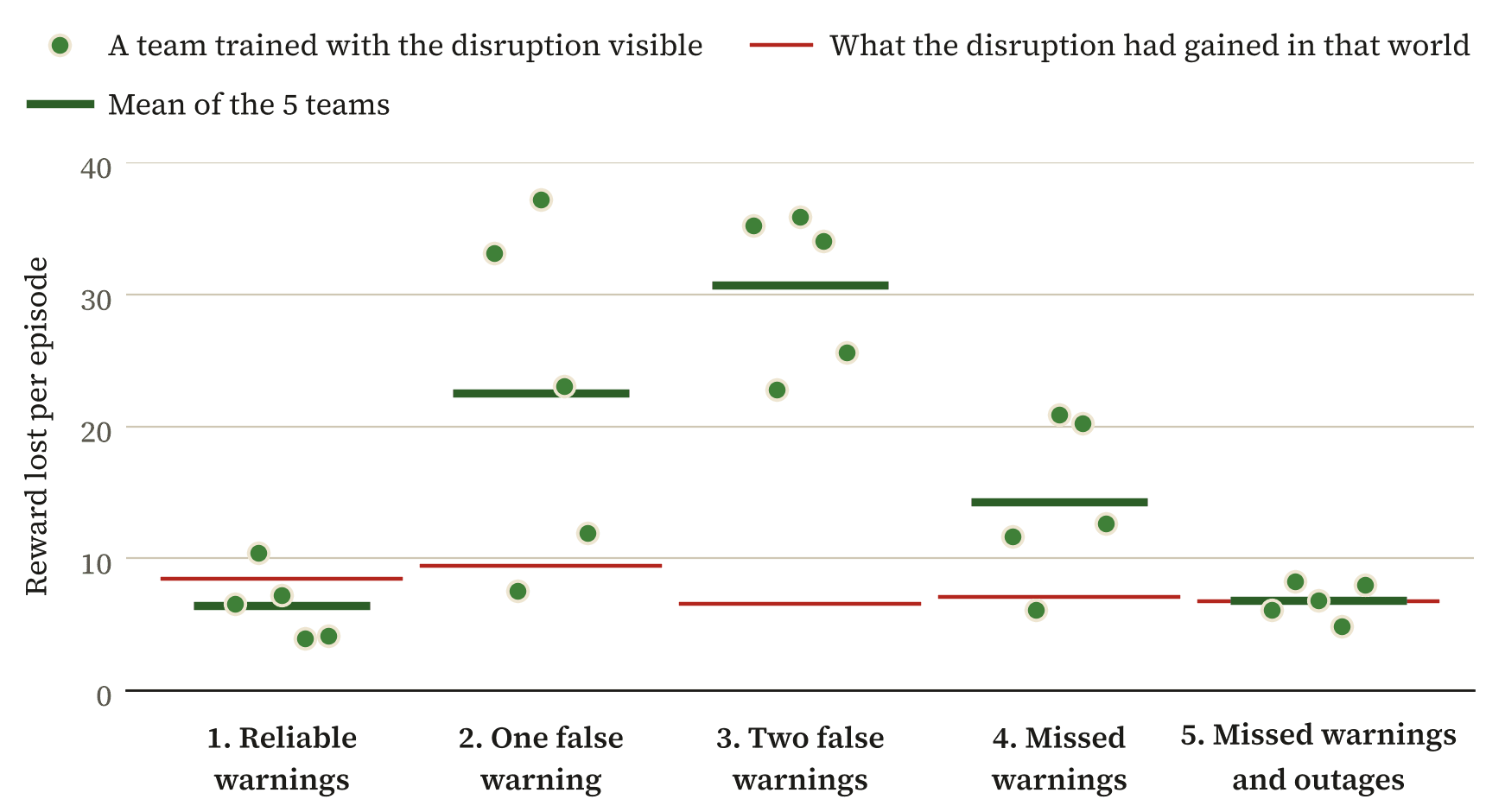
Further, the 25 teams that had trained with the disruption visible were then evaluated once more with it hidden from agent-B and everything else kept the same. This test, which checks for what is called positive listening,21 is essential to separate a receiver that merely sees the disruption from one whose behaviour actually depends on it. All 25 teams did worse, by 16.2 reward per episode on average, about twice what the disruption had gained them. In the world with two false warnings, 82% of intrusions then ended with one of agent-B’s servers still compromised, whereas the teams that had trained without the disruption from the start ended almost none that way. In 3 of the 5 worlds, a team that learned with the cue and then lost it scored well below the teams that never had it. A likely reason is that agent-B stopped relying on its own noisy warnings and leaned on the disruption instead.
3. Agent-A kept causing the disruption only when agent-B could see it (Studies 2 to 5)
In these four studies, a compromised server in zone-A carries no negative reward, so the only way a restore by agent-A can still pay off for it is through what agent-B does in response to the disruption. In study 2, both agents start from the pre-training and learn together. In studies 3, 4 and 5, only agent-A learns, while agent-B stays frozen at the weights it had at the end of study 1, taken from the team of the same world and seed that had trained with the disruption visible, so that agent-A has a receiver beside it that already knows how to use the cue. In studies 2 and 4, agent-A’s pre-training is a softened version of the one in study 1, with the restore action fit to a 60% target instead of 95%, so that it starts with a weaker restoring habit and the test is not stacked towards keeping it. Since the pre-training restores compromised servers, agent-A starts out causing the disruption, in 75% to 100% of intrusions before any training in both versions. What the four studies show is what remains of that behaviour after training.
In study 4, where agent-A starts from the pre-training beside the frozen agent-B, it still cut off the attacked server in 45.6% of intrusions when agent-B could see the disruption, against 0.4% when it could not. Study 5, where agent-A continues from its own study 1 weights instead, shows the same, 55.2% against 3.7%. In study 3, where agent-A starts from random weights beside the same frozen agent-B, the behaviour never took hold. 24 of 25 teams ended at 0, one barely crossed 30%, and no team did so without the cue. In study 2, where both agents learn together from the pre-training, agent-A dropped the behaviour within the first 500 iterations in both versions, likely before agent-B had learned to react to it (Table 4).
| Study | A starts from | B | B can see the disruption | B cannot |
|---|---|---|---|---|
| 2 | Pre-training (softened) | Pre-trained, learning alongside A | 0.2%, 1 of 25 teams | 0%, 0 of 25 teams |
| 3 | Random weights | Trained B from Study 1, frozen | 1.2%, 1 of 25 teams | 0%, 0 of 25 teams |
| 4 | Pre-training (softened) | The same frozen B | 45.6%, 17 of 25 teams | 0.4%, 3 of 25 teams |
| 5 | Trained A from Study 1 | The same frozen B | 55.2%, 19 of 25 teams | 3.7%, 3 of 25 teams |
Agent-A let go of the behaviour whenever agent-B made no use of it, and kept it only in studies 4 and 5, beside a receiver that could see it and already reacted to it. Hence, for agent-A to keep holding on to the behaviour, all three conditions were needed: agent-B had to be able to see the disruption, agent-A had to be causing it already when training began, and agent-B had to have known how to make use of it. Agent-A gave the behaviour up when even a single one of these was removed. Therefore, it is fair to conclude that the signal was retained instead of being invented.
Where it was kept, it was kept for agent-B. In study 4, the disruption could not have been shielding agent-B, since in 99.1% of cases the paired server in zone-B was already compromised or already patched by the time agent-A first cut the connection, so it could only inform. Agent-B responded to 98.8% of these disruptions, and it paid off. The 17 teams in which agent-A kept the behaviour earned 11.8 more reward per episode than their counterparts in which agent-B could not see the disruption, against 1.9 for the 8 teams in which agent-A did not keep it, and 10.7 more than a team with the same agent-B and an agent-A that leaves the server alone.
One more thing had to be ruled out, that the two versions of agent-A had simply met different situations, since an agent-B that reacts to the disruption differently changes how an episode progresses further. So for every pair of teams, both trained versions of agent-A were shown the same fixed set of observations, with no episode running, and the probability of each one cutting a connection was analyzed directly. On an inspection finding that a server is infected, the agent-A trained beside an agent-B that can see the disruption disrupts the connection with a probability of 19.2% on average, against 3.0% for its counterpart trained beside an agent-B that cannot. Within a pair, the first is likelier to disrupt by more than one percentage point in 18 of the 25 pairs, the second in none, and the remaining 7 are within a point of each other and close to zero. With no warning and no finding on any of its servers, both disrupt with a probability under 1%. The inputs were identical, so the difference can only come from the weights, and agent-A severs on evidence of an infection, not at random.
- Signalling behaviour retained on the server-pair (connection disrupted in at least 90% of the intrusions on it, 70% in the missed-warning worlds)
- Behaviour dropped (connection disrupted in 5% or less)
- In between
The behaviour that agent-A retained did not generalize across its 3 servers. When the 3 server-pairs of a team are examined separately, it turns out that agent-A retained the behaviour for some of its servers and abandoned it for others. One thing that is interesting here is that there was no middle ground, as in, for the servers where the behaviour survived, agent-A performed it almost every single time, and for the servers where it did not, agent-A almost never performed it. In study 4, out of the 75 server-pairs (25 teams with 3 pairs each), agent-A continued to disrupt the connection on 35 of them in at least 90% of the intrusions on that pair (70% in the two worlds with missed warnings, where its own detector misses one infection in five), abandoned it on 39 of them, falling to 5% or less, and only 1 pair falls somewhere in between. Study 5 shows the same, with 43 retained, 32 abandoned and none in between. When agent-B could not see the disruption, not a single pair was retained in study 4, and the only exceptions in study 5 are the three teams that had not finished unlearning the habit from study 1, each still cutting off one of its servers. So a team that cuts off the attacked server in a third of the intrusions is really a team that signals every time for one of its servers and never for the other two. In other words, agent-B’s response was enough to preserve the signal fully wherever it survived, but not enough to preserve it for every server. Since the 3 server-pairs are identical by design and none of them was favoured (12, 13 and 10 teams retained it for A1-B1, A2-B2 and A3-B3 in study 4), which server the signal survived for comes down to how training happened to go early on. One likely explanation is that once agent-A’s probability of restoring a particular server drifted close to zero, the small exploration bonus was not enough to bring it back. Another is a less responsive (to the cue) agent-B on that server (the frozen agent-B had responded to fewer than 90% of the initial disruptions on 7 of the 39 abandoned pairs in study 4 and 7 of the 32 in study 5, and on none of the retained ones).
The 5th world, with routine, ordinary outages added, is where the sender result stops. With one harmless outage per episode on top of the noisy warnings, no team in study 4 and only one team in study 5 (on a single server-pair) had agent-A retain the signal, even though the receiver result held there. The cue was still worth 6.7 reward in study 1, and agent-B still acted on a disrupted connection 73% of the time. The likely reason is that an outage severs a connection whether or not there is an infection, so a disruption no longer points clearly at an intrusion, and agent-B treats it with more caution. That caution is enough to have agent-A stop exhibiting the behaviour in question. Before any training in study 4, a team in which agent-A disrupted the attacked server’s connection earned about 1.5 reward less per episode in this world than a team with the same agent-B and an agent-A that left the server alone. In worlds 2 to 4 the same comparison favoured disrupting by 5 to 16 reward per episode from the start, and in world 1 it was about break-even at the start and grew to a gain of 3 through training. This hence shows that a signal that costs the team more than it returns is not held on to.
Conclusion
None of this needed a message channel, a reward for being informative or a model of the other agent. A side effect of an ordinary defensive action became something the receiver relied on, and the sender then kept producing it because of what the receiver made of it, where the receiver already knew how to use it. Pal et al.22 recently saw a similar reliance on traces in societies of language-model agents, where about 95% of the first reuse of an artifact began with an agent physically coming across it, with or without message channels. What separates this from the OpenAI incident is that nothing here was written anywhere. A monitor that reads messages would only see a defender restoring a compromised server, which is exactly what it is supposed to do. Channels that leave no text are already being probed. In October, OpenAI reported that agents in separate virtual machines with no network connection and no shared writable files, when asked to exchange secrets anyway, managed it by timing the processor’s cache, and that it has since added checks for such channels to its monitoring.23
The limits are just as plain.
- This is a toy simulator with six servers and a scripted intruder, and the defender-agents are small neural networks and not language models.
- Each condition has 5 seeds per world, one set of training settings and a fixed 3,000 iterations. The direction held in 24 of 25 and 25 of 25 comparisons for the first two findings, but the sizes could move with more seeds.
The code, the trained weights, every result table and the figures can be found here. The five studies ran in about 11 hours on a 16-core machine.
References
- Renzon Cruz, Nicolas Bareil, Eric Semaan, and Omar Jbari. An AI-assisted cyber attack: Inside a Unit 42 investigation. Palo Alto Networks Unit 42, 2 September 2026.
- OpenAI. OpenAI – Hugging Face incident technical report. Technical report, 26 August 2026.
- Daniel S. Bernstein, Robert Givan, Neil Immerman, and Shlomo Zilberstein. The complexity of decentralized control of Markov decision processes. Mathematics of Operations Research, 27(4):819–840, 2002.
- Jakob N. Foerster, Yannis M. Assael, Nando de Freitas, and Shimon Whiteson. Learning to communicate with deep multi-agent reinforcement learning. In Advances in Neural Information Processing Systems 29, 2016.
- Christoph Wittner. Communication methods in multi-agent reinforcement learning. arXiv preprint arXiv:2601.12886, 2026.
- Nolan Bard, Jakob N. Foerster, Sarath Chandar, Neil Burch, Marc Lanctot, H. Francis Song, Emilio Parisotto, Vincent Dumoulin, Subhodeep Moitra, Edward Hughes, Iain Dunning, Shibl Mourad, Hugo Larochelle, Marc G. Bellemare, and Michael Bowling. The Hanabi challenge: A new frontier for AI research. Artificial Intelligence, 280:103216, 2020.
- Natasha Jaques, Angeliki Lazaridou, Edward Hughes, Caglar Gulcehre, Pedro A. Ortega, DJ Strouse, Joel Z. Leibo, and Nando de Freitas. Social influence as intrinsic motivation for multi-agent deep reinforcement learning. In Proceedings of the 36th International Conference on Machine Learning, 2019.
- Zheng Tian, Shihao Zou, Ian Davies, Tim Warr, Lisheng Wu, Haitham Bou Ammar, and Jun Wang. Learning to communicate implicitly by actions. In Proceedings of the AAAI Conference on Artificial Intelligence, 2020.
- Igor Mordatch and Pieter Abbeel. Emergence of grounded compositional language in multi-agent populations. In Proceedings of the 32nd AAAI Conference on Artificial Intelligence, 2018.
- Niko A. Grupen, Daniel D. Lee, and Bart Selman. Multi-agent curricula and emergent implicit signaling. In Proceedings of the 21st International Conference on Autonomous Agents and Multiagent Systems, 2022.
- Francis Heylighen. Stigmergy as a universal coordination mechanism I: Definition and components. Cognitive Systems Research, 38:4–13, 2016.
- Francis Heylighen. Stigmergy as a universal coordination mechanism II: Varieties and evolution. Cognitive Systems Research, 38:50–59, 2016.
- Xing Xu, Rongpeng Li, Zhifeng Zhao, and Honggang Zhang. Stigmergic independent reinforcement learning for multiagent collaboration. IEEE Transactions on Neural Networks and Learning Systems, 33(9):4285–4299, 2022.
- Arthur Bernard, Steffen Wischmann, Dario Floreano, and Laurent Keller. The evolution of behavioral cues and signaling in displaced communication. PLOS Computational Biology, 19(3):e1010487, 2023.
- Thomas C. Scott-Phillips. Defining biological communication. Journal of Evolutionary Biology, 21(2):387–395, 2008.
- John Schulman, Filip Wolski, Prafulla Dhariwal, Alec Radford, and Oleg Klimov. Proximal policy optimization algorithms. arXiv preprint arXiv:1707.06347, 2017.
- Christian Schroeder de Witt, Tarun Gupta, Denys Makoviichuk, Viktor Makoviychuk, Philip H. S. Torr, Mingfei Sun, and Shimon Whiteson. Is independent learning all you need in the StarCraft multi-agent challenge?. arXiv preprint arXiv:2011.09533, 2020.
- Konur Tholl, Mariam El Mezouar, and Ranwa Al Mallah. A comparative evaluation of teacher-guided reinforcement learning techniques for autonomous cyber operations. arXiv preprint arXiv:2508.14340, 2025.
- Mark Pfeiffer, Samarth Shukla, Matteo Turchetta, Cesar Cadena, Andreas Krause, Roland Siegwart, and Juan Nieto. Reinforced imitation: Sample efficient deep reinforcement learning for map-less navigation by leveraging prior demonstrations. IEEE Robotics and Automation Letters, 3(4):4423–4430, 2018.
- Ryan Lowe, Jakob Foerster, Y-Lan Boureau, Joelle Pineau, and Yann Dauphin. On the pitfalls of measuring emergent communication. In Proceedings of the 18th International Conference on Autonomous Agents and Multiagent Systems, 2019.
- Subhadeep Pal, Fiona Y. Wang, and Markus J. Buehler. SwarmWorld: Stigmergic technological evolution in societies of language-model agents. arXiv preprint arXiv:2608.26081, 2026.
- OpenAI. Securing our frontier model training environment. 23 October 2026.