Diefenbunker
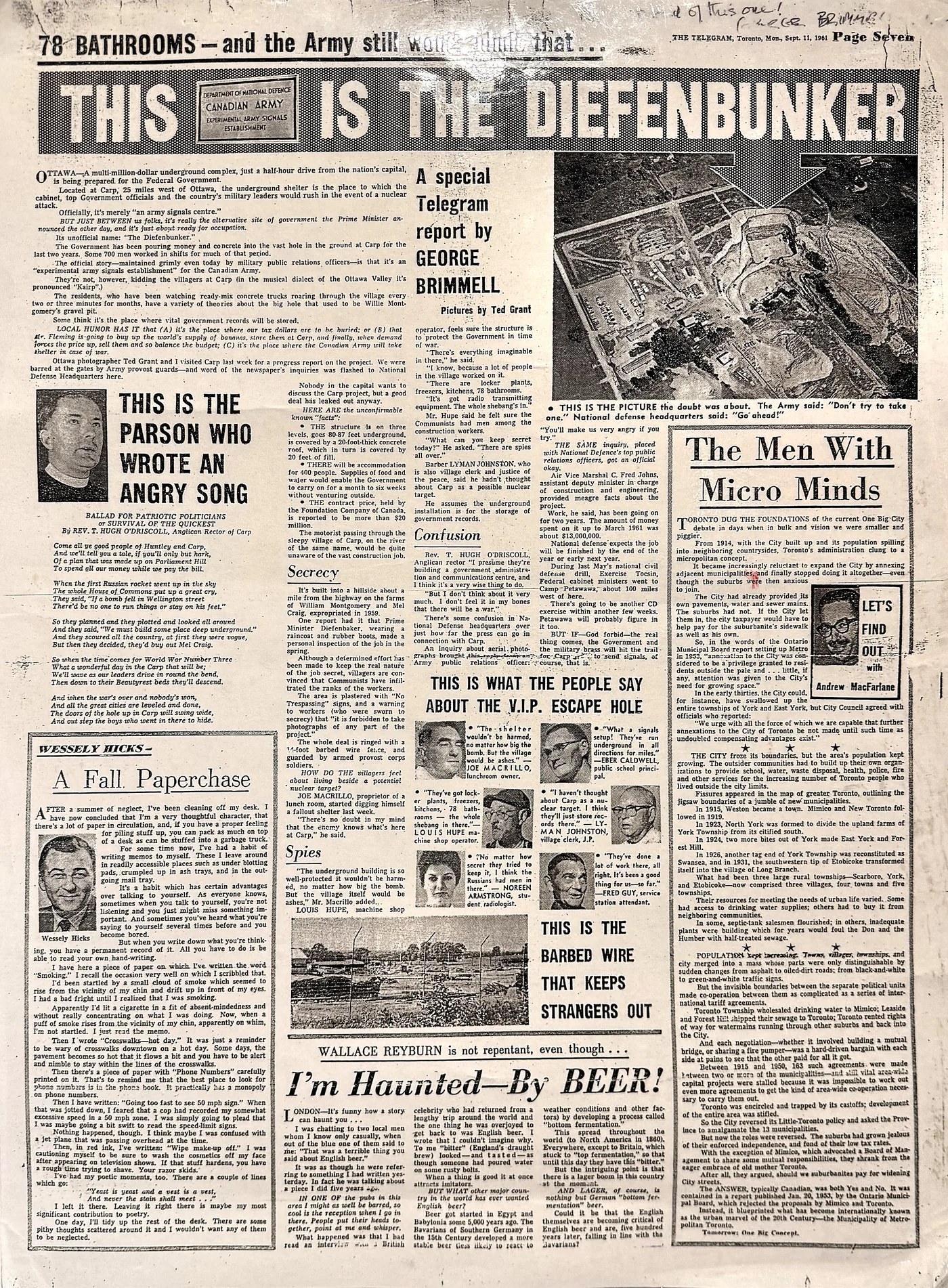
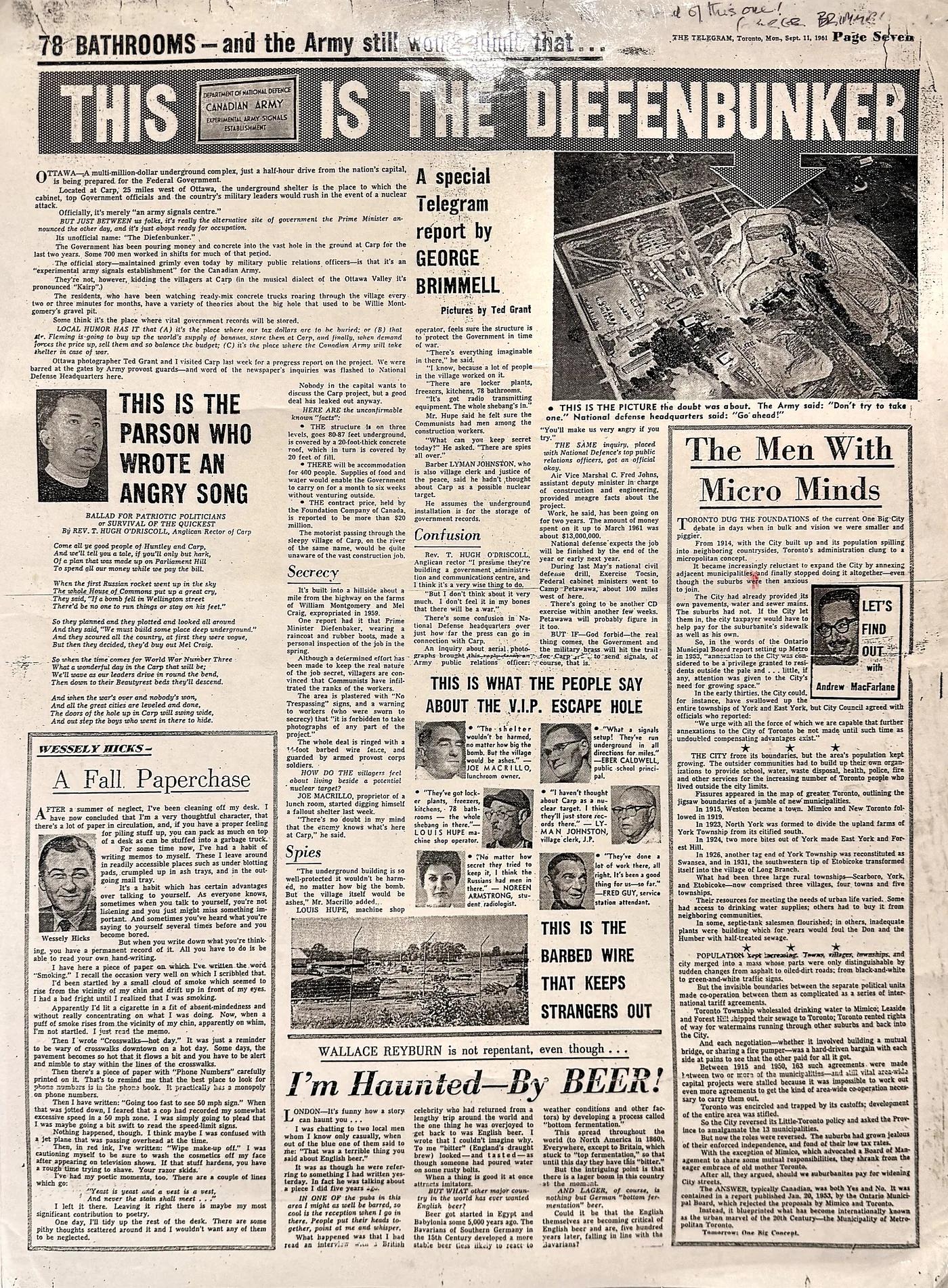
78 BATHROOMS — and the Army still won’t admit that…
The Telegram, Toronto, Mon., Sept. 11, 1961 · Page Seven
This Is the Diefenbunker
That was the headline on page seven of the Toronto Telegram on Monday, September 11, 1961.1 I came across a copy of it hanging on a wall tens of feet underground, inside the very building about which the newspaper had all but blown the whistle.
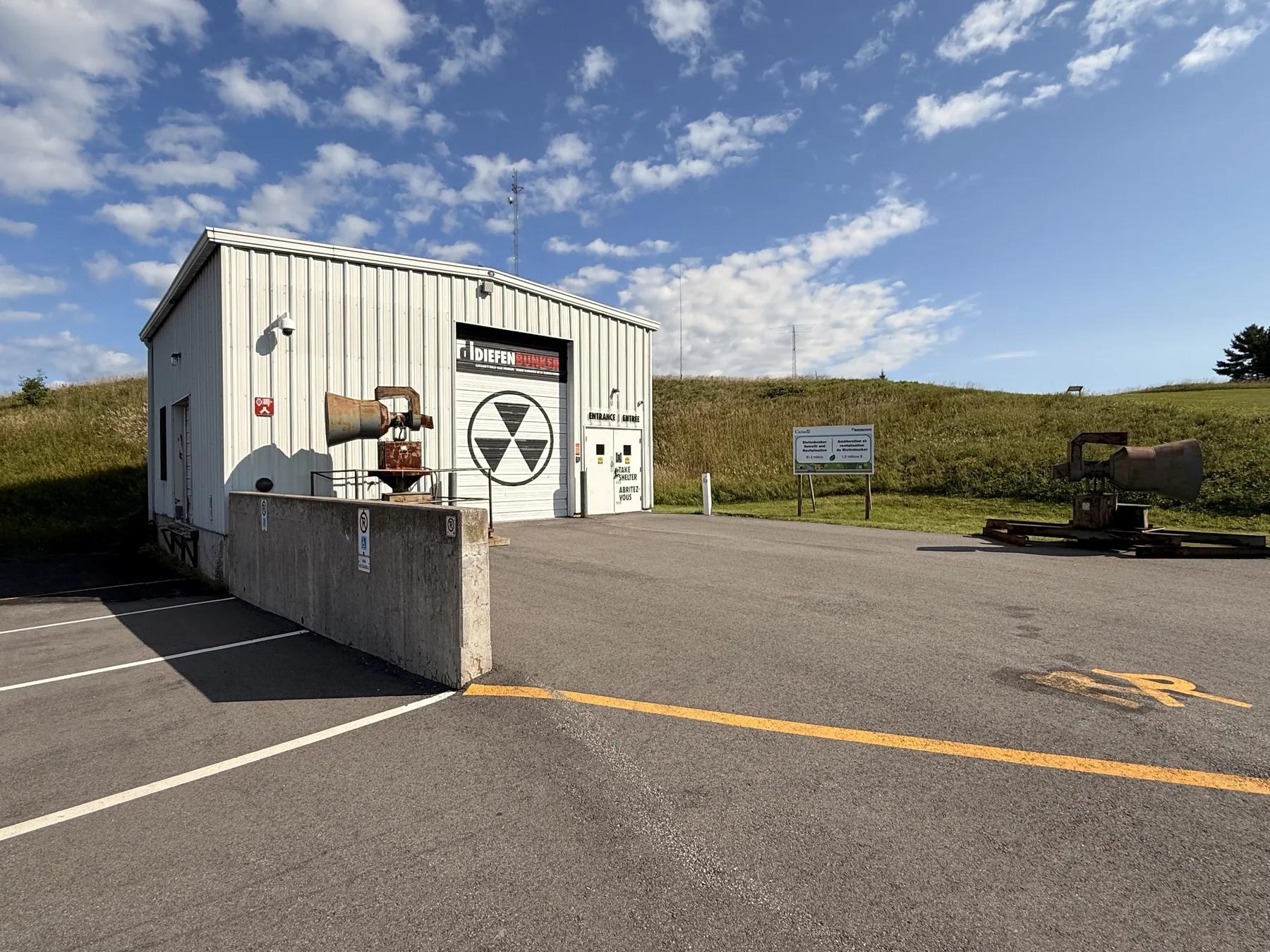
I went out to see the Diefenbunker earlier this year in August when I was working about twenty minutes away from the place in Ottawa. From the road, you’d drive right past it if you weren’t looking. It sits under a completely ordinary grassy hill outside the capital with a little metal hut sticking out of the dirt and two chunky rusted air-raid sirens parked in front like lawn ornaments. Looking at it, you’d never guess there’s a massive 4-storey, 100,000-square-foot complex buried right beneath your feet.2 Which makes it kind of funny that they went to all that trouble to disguise a nuclear bunker as a random farm shed, only to blow the whole thing over toilets.
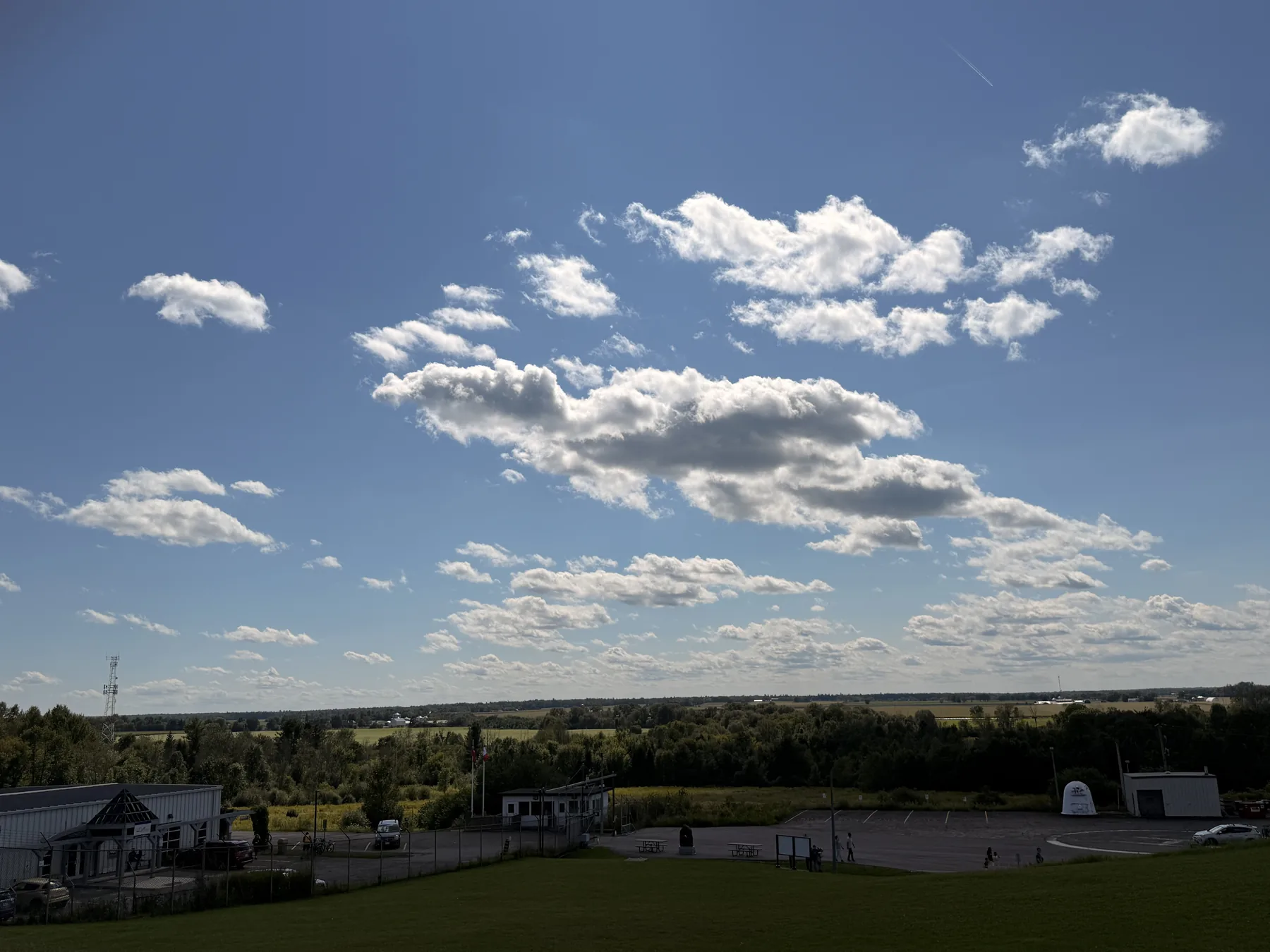
Back in 1959, the Canadian government started quietly pouring concrete into a giant hole in Carp, a small village west of Ottawa. Officially, it was the Experimental Army Signals Establishment, or Project EASE, which seems the perfect amount of boring if you’re trying to get people to stop asking questions.3 The problem was that you can’t sneak 700 construction workers and months of concrete trucks passing through a tiny village every two or three minutes without people noticing. Carp had theories. According to the Telegram, locals floated the idea that it was a vault for tax dollars, or that Finance Minister Donald Fleming was secretly buying up the world’s supply of bananas to stash them in Carp and sell them when the price went up, thereby balancing the federal budget.1
The Army’s cover story had become something of an open secret by then. In 1961, George Brimmell of the Telegram and photographer Ted Grant investigated the site from the air, and they noticed something particularly weird that settled whatever doubt remained; they saw 78 toilets. No one needs 78 bathrooms for an experimental radio shack.14
What was being built was the Central Emergency Government Headquarters (CEGHQ), commissioned by then Canadian Prime Minister John Diefenbaker at the height of the Cold War. The idea was that in the event of a nuclear attack on Canada, the people responsible for running the country would continue to do so from underneath a village in Ontario.5
Inside, you walk down a long corrugated-steel blast tunnel designed to divert the shockwave of a nuclear explosion away from the bunker’s blast doors.6 Beneath the grass sits a reinforced-concrete box built to keep roughly 535 people, including the Prime Minister, senior cabinet, military brass, and support staff alive for about 30 days.7
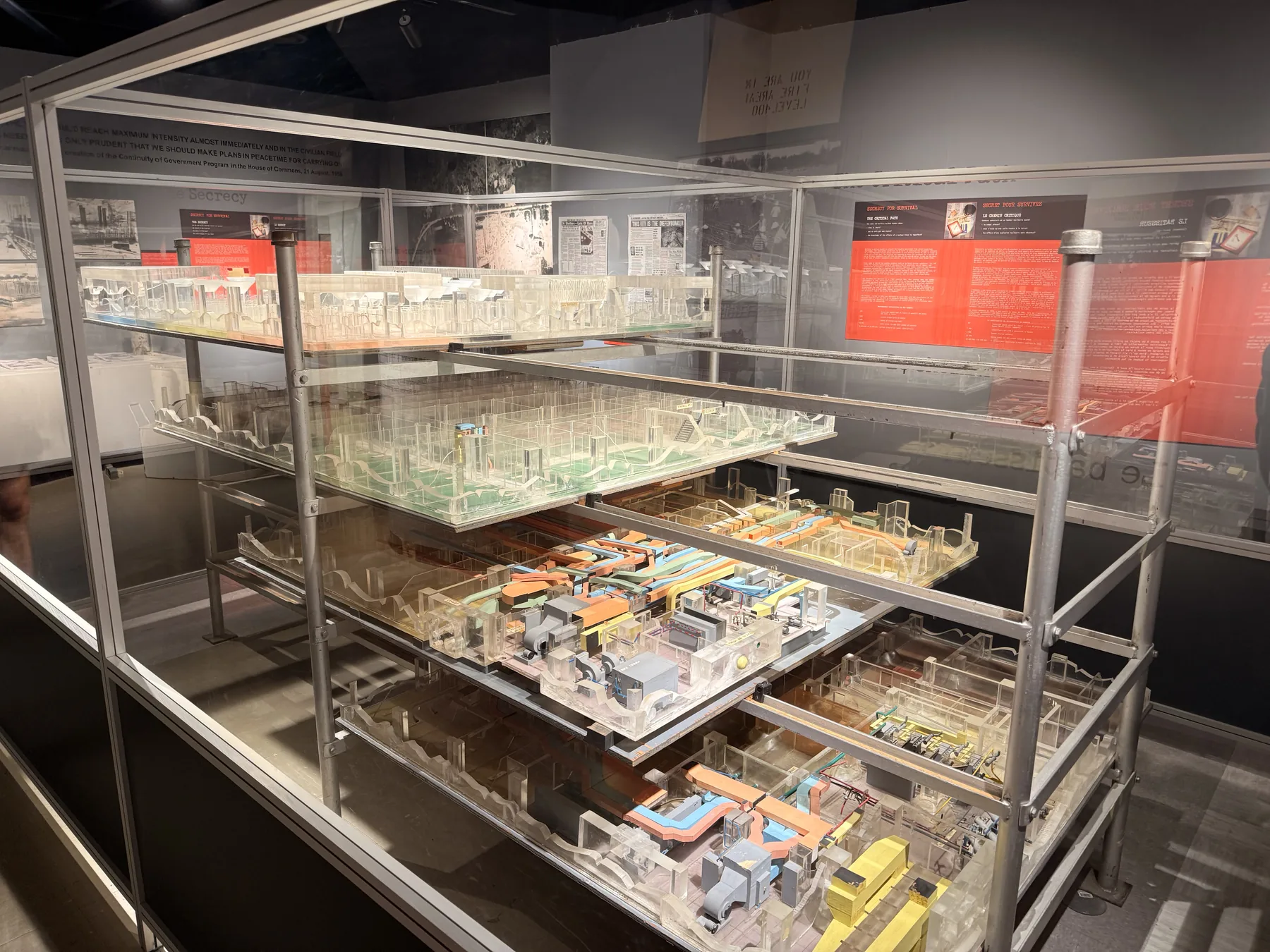
Engineering-wise, the place is genuinely inspirational. The first site the government picked in nearby Lanark County had to be abandoned because groundwater flooded it,6 and unlike the Americans, who could just hollow out a granite mountain for NORAD, Ottawa was troubled by the lack of a convenient mountain just lying around.3 Instead, they dug a giant pit, poured 32,000 cubic yards of concrete around 5,000 tons of steel, and wrapped the whole structure in a five-foot-thick cushion of compacted gravel. The idea was that if a five-megaton nuclear bomb went off 1.8 kilometres away, the entire building could literally shift a few inches inside the gravel without cracking.63 It was also the first recorded use of the Critical Path Method for construction scheduling in Canada, which helped them pull the whole thing off in just 18 months.68
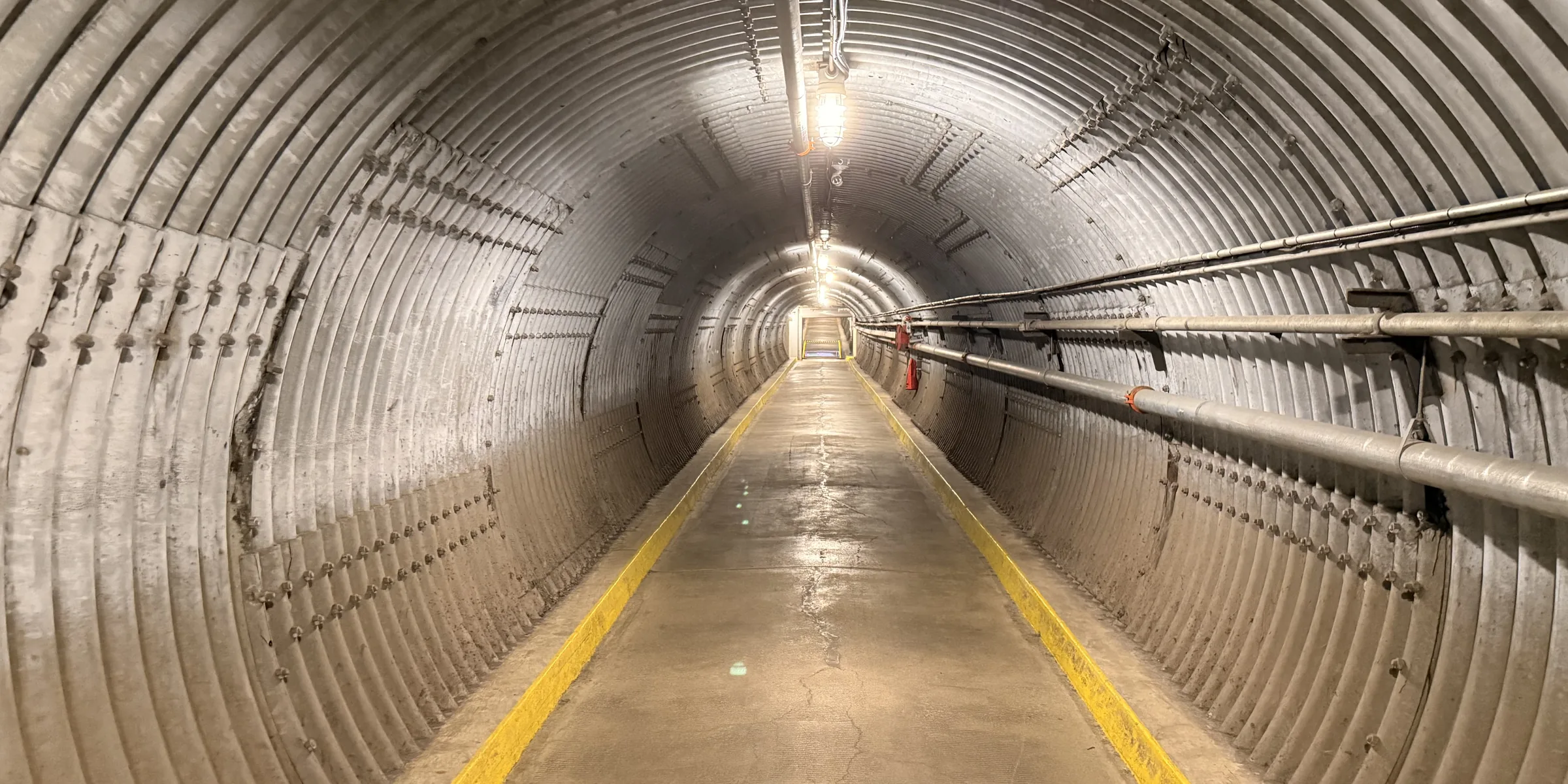
The blast tunnel Built to carry the shockwave of a blast past the bunker rather than into it.
In the event of an imminent nuclear attack, these people would have had to make their way to Carp, step behind two-tonne blast doors and, if necessary, undergo decontamination, knowing they weren’t allowed to bring their families.6 No kids, no spouses, not even the Prime Minister’s wife.25 They’d spend the next 30 days rotating through shared bunks in eight-hour shifts,9 walking past the bunker’s very own morgue,10 with a device called the “Rad Sniffer” monitoring radiation levels outside.7 And if the main tunnel collapsed in the blast, their only way out was pulling a lever to dump 13 tonnes of pea gravel out of a vertical shaft and climbing out one by one.7
That no-spouses rule is actually why Diefenbaker flat-out refused to ever set foot inside it.25 In 32 years of operation, only one sitting Prime Minister ever toured the bunker, Pierre Trudeau in 1976, who cut its funding almost immediately after his visit.711
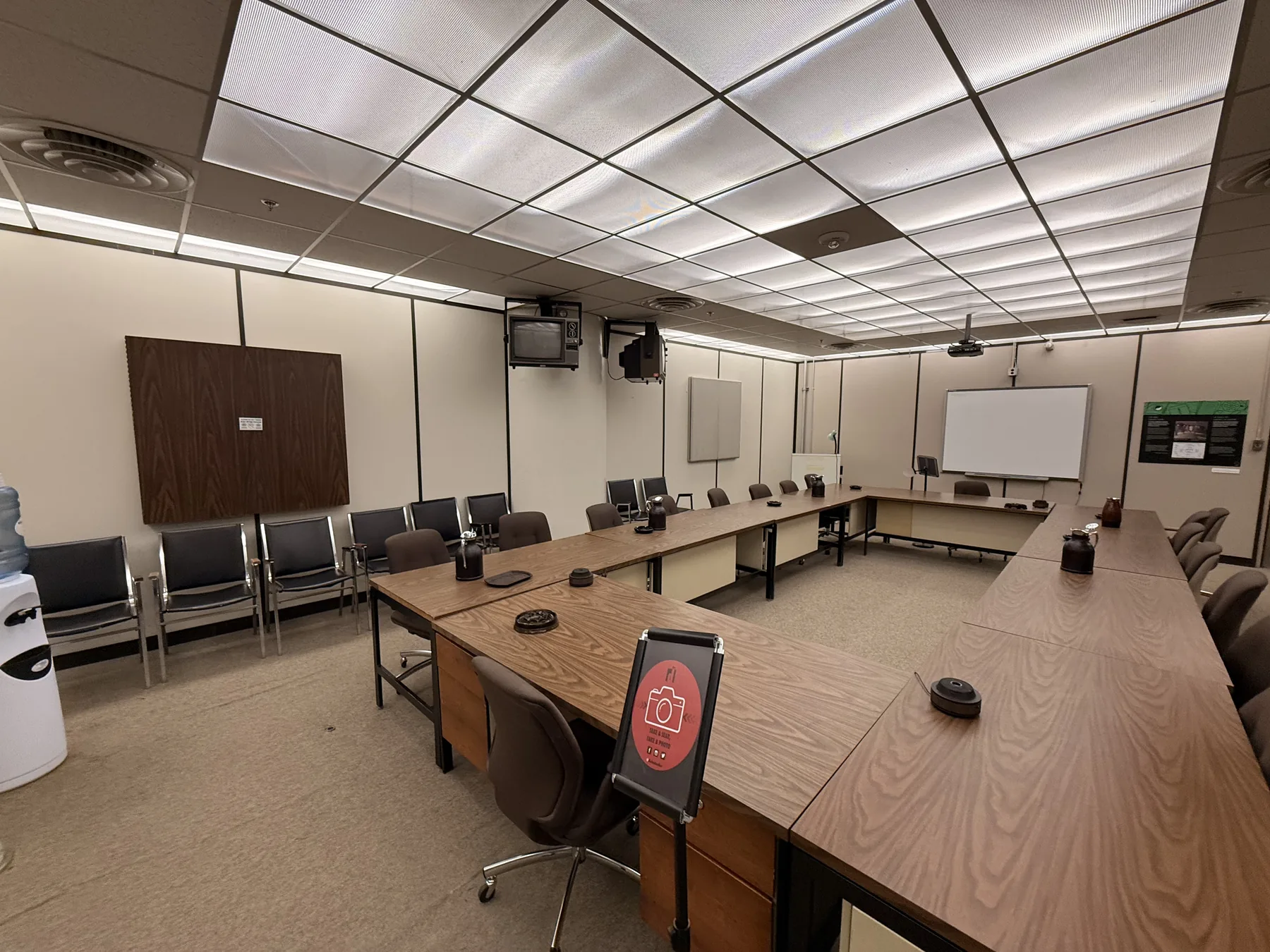
The War Cabinet Room Where the country would have been run from, had it come to that.
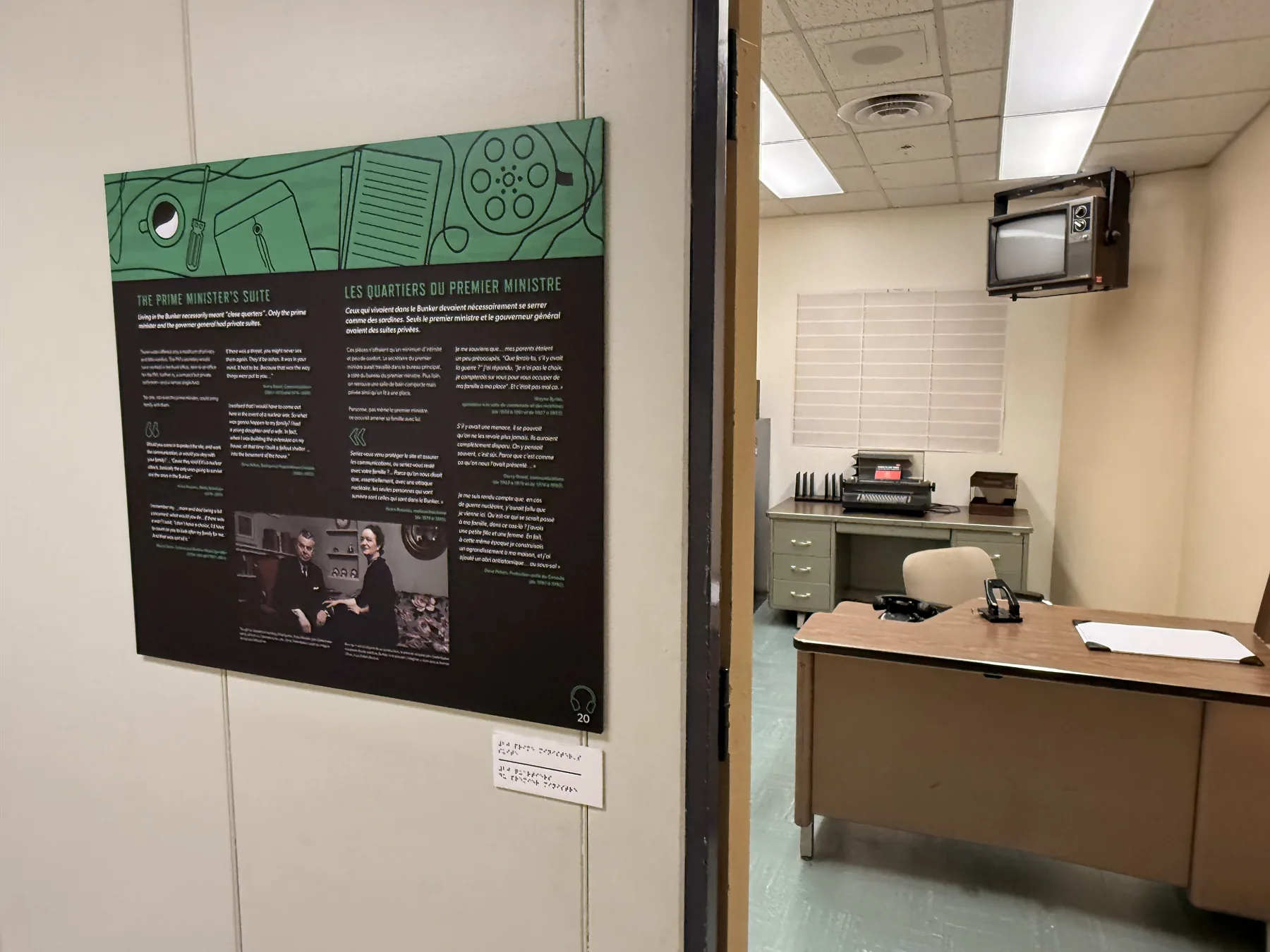
The Prime Minister’s suite One of only two private suites in the bunker, the other being the Governor General’s.
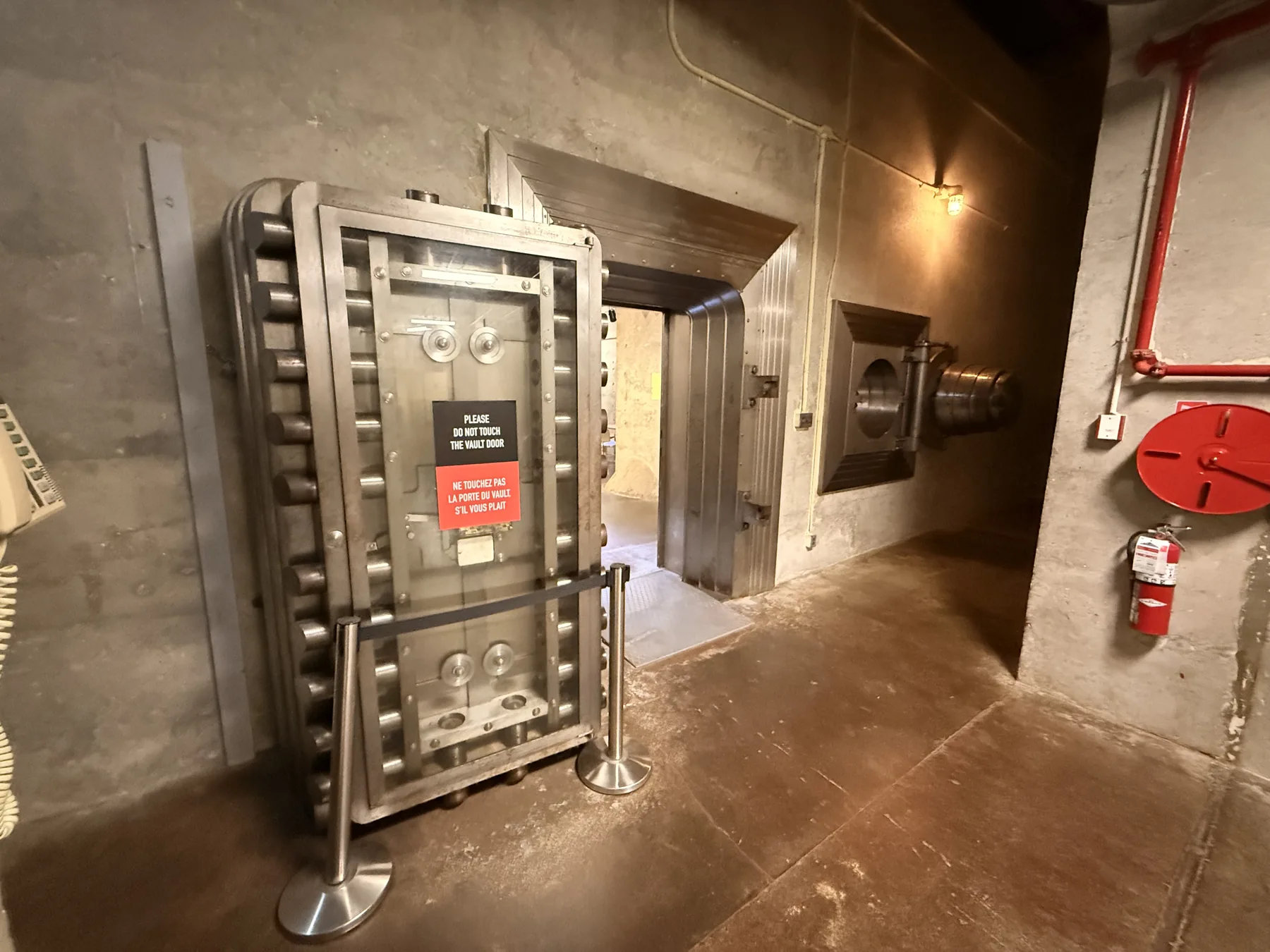
Walking through the rest of the bunker, the details just keep getting weirder. Mounted on a bright yellow board in the communications wing are red-painted hammers and an axe, which was the actual protocol for smashing the cryptographic gear if the Soviets ever made it to Carp.12 On the bottom floor sits an enormous Bank of Canada vault, built to hold 725 tonnes of the country’s gold reserves behind a 12-tonne door. In peacetime, the staff apparently used it to keep their beer cold.1213 They also wired an entire CBC radio studio down here so Canada could still broadcast public radio into the fallout, guiding the public through fallout warnings, emergency directives, and the quiet reassurance that a government still existed somewhere underground.7
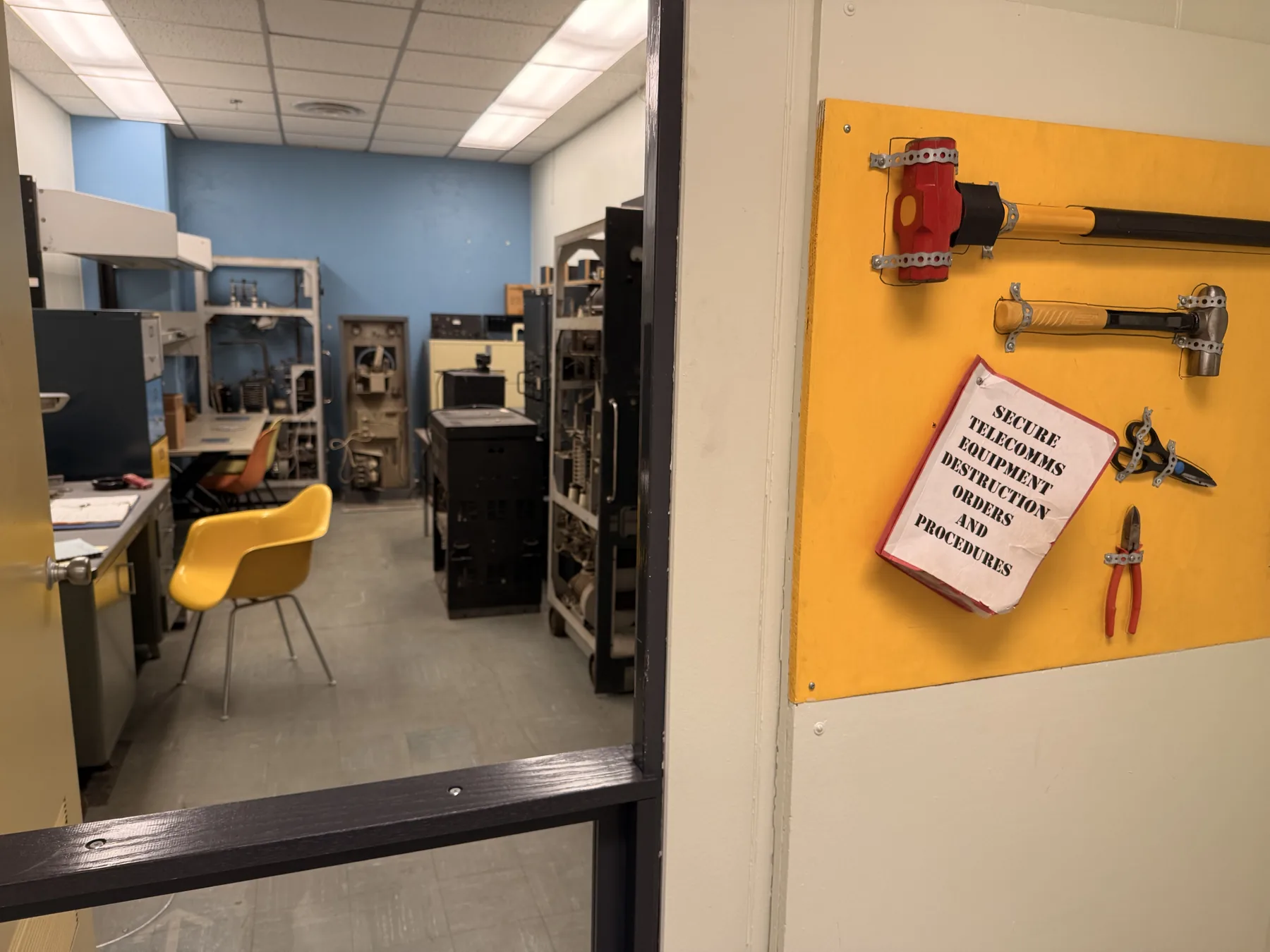
Destruction orders and procedures Tools for smashing the secure communications gear
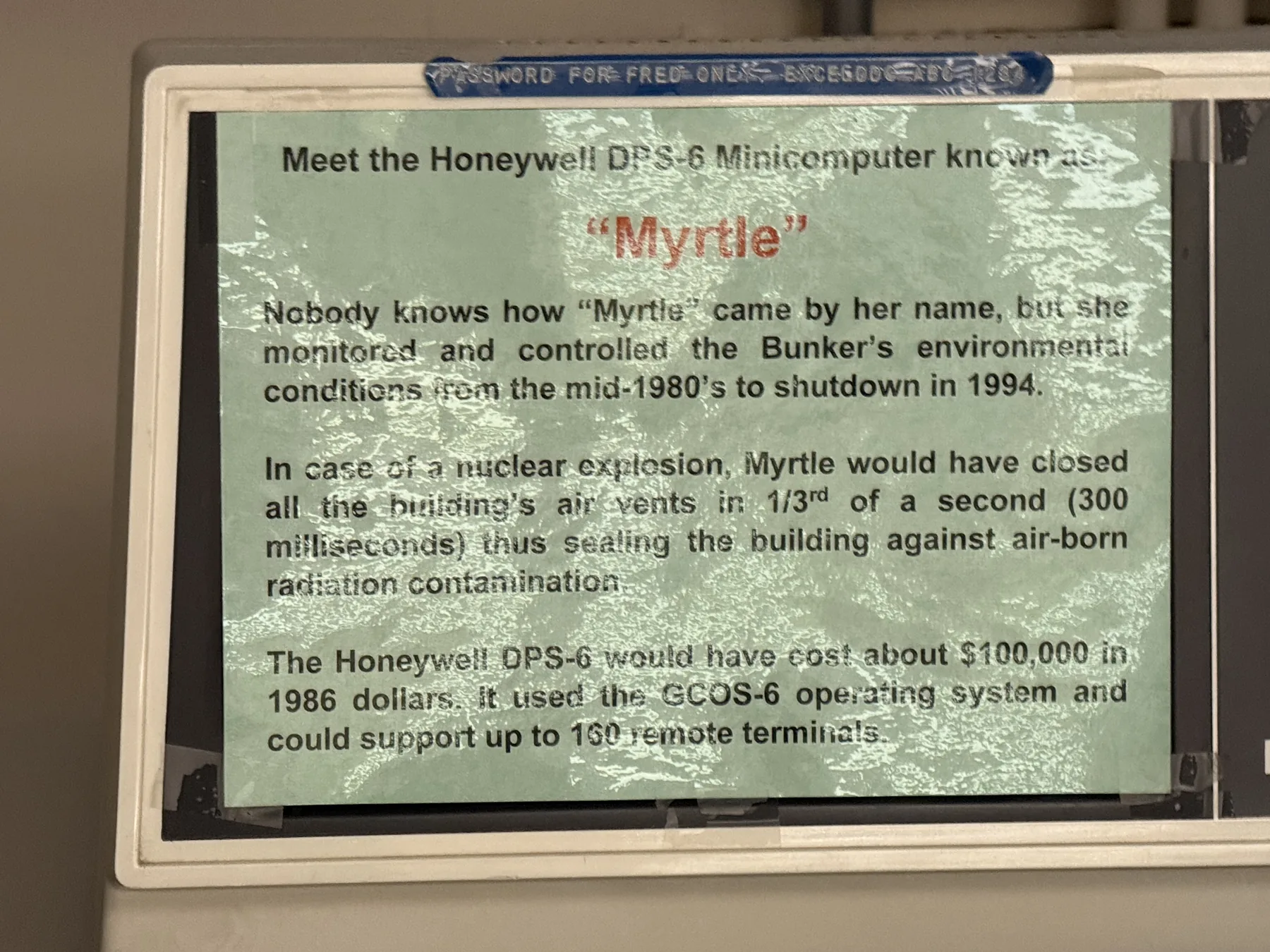
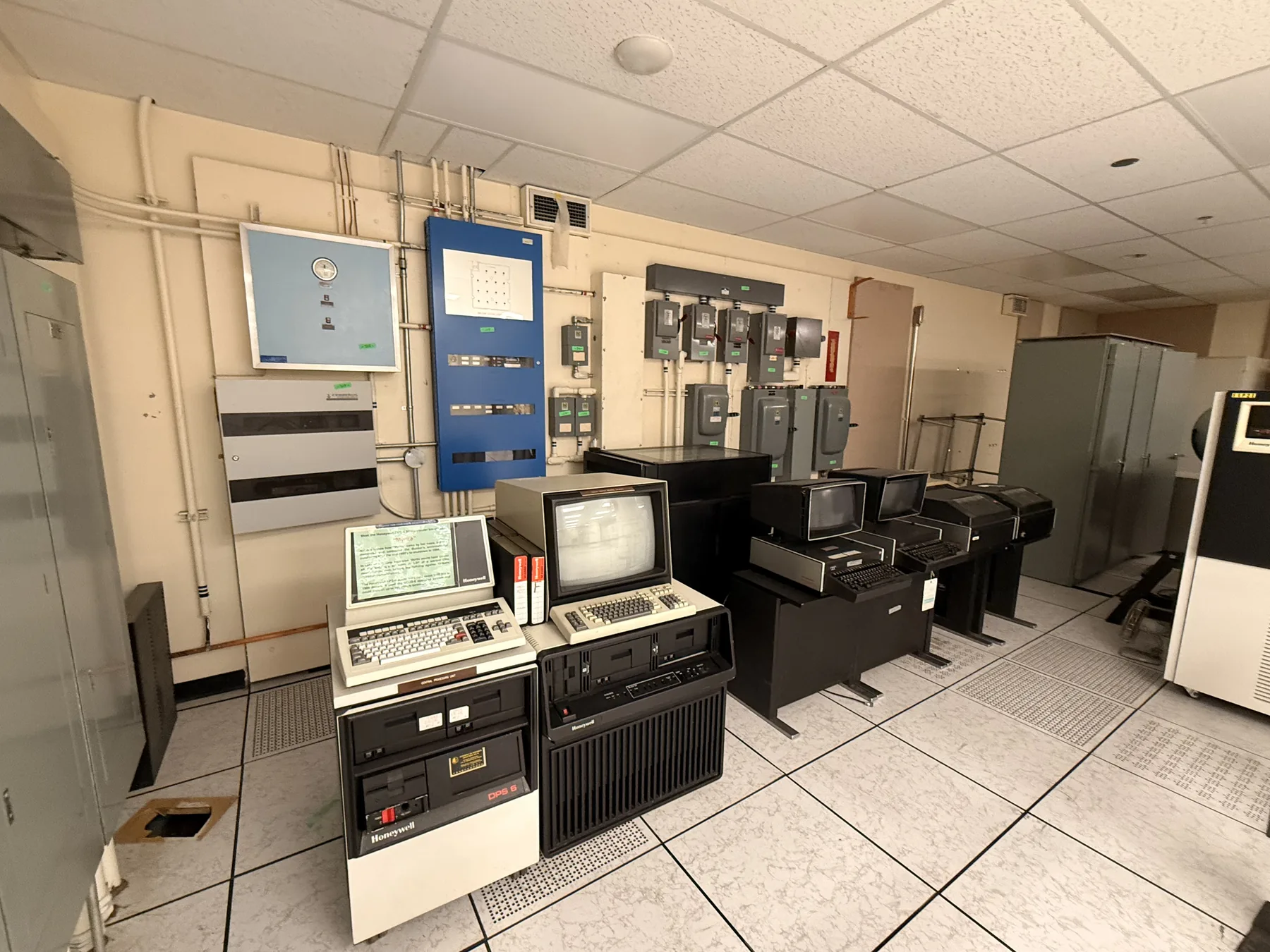
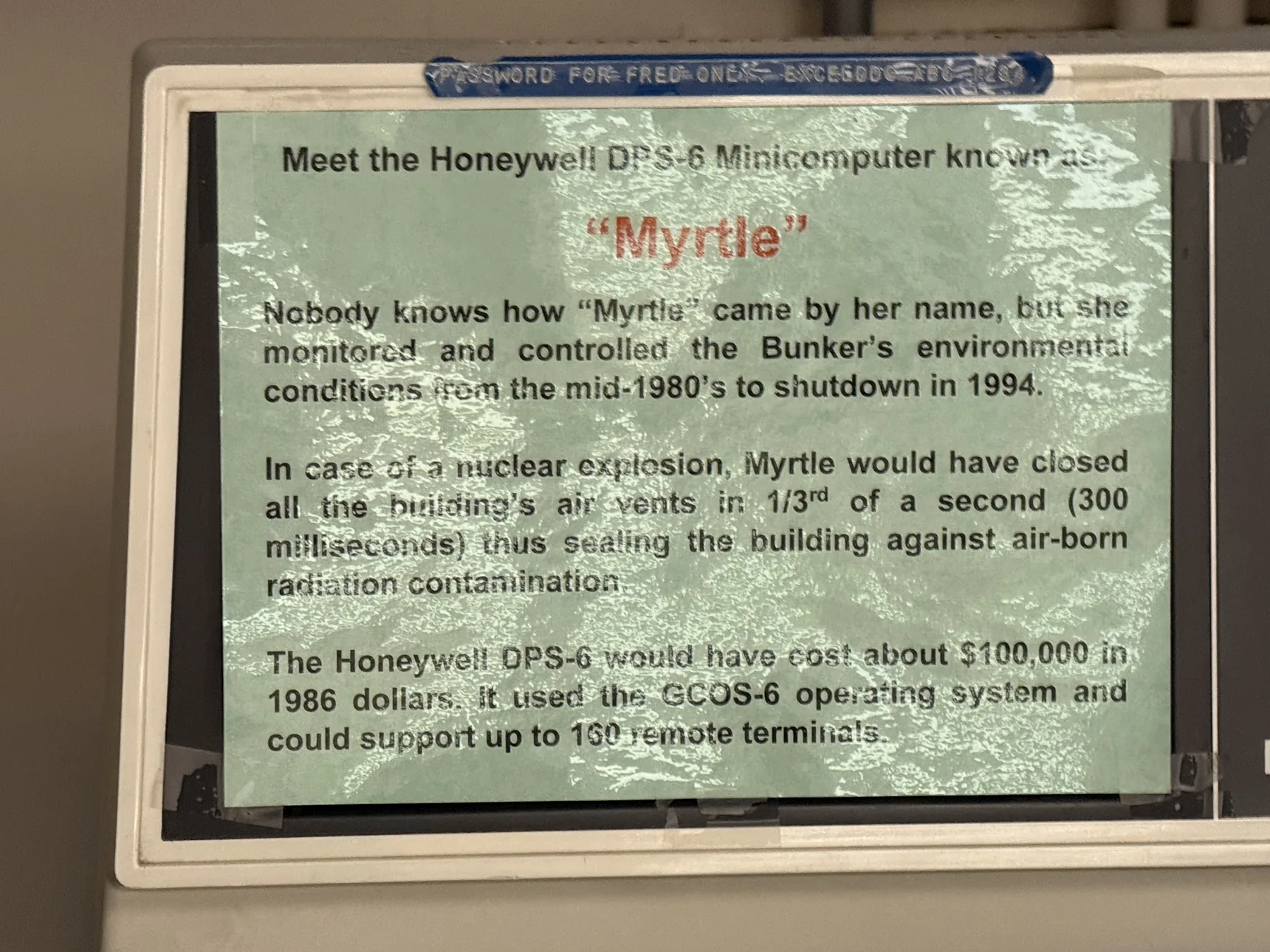
You also get to see Myrtle here at the Diefenbunker. Myrtle is a Honeywell DPS-6 minicomputer that monitored and controlled the bunker’s environmental conditions from the mid-1980s until its closure in 1994. In the event of a nuclear explosion, Myrtle would have shut all the building’s air vents in approximately 300 milliseconds. She would have cost around $100,000 in 1986.14
Three years after the Cold War ended in 1991, the Diefenbunker was decommissioned. Over the following years, it came remarkably close to having its entrance tunnel permanently filled with concrete.4 Its eventual revival as a museum began rather unexpectedly. In 1995, a local library board member named Dixie Trenholm peeked inside and realized that tours of the bunker might raise more money for the new town library than a used book sale.10 The tours brought in $40,000 in their first nine days.15
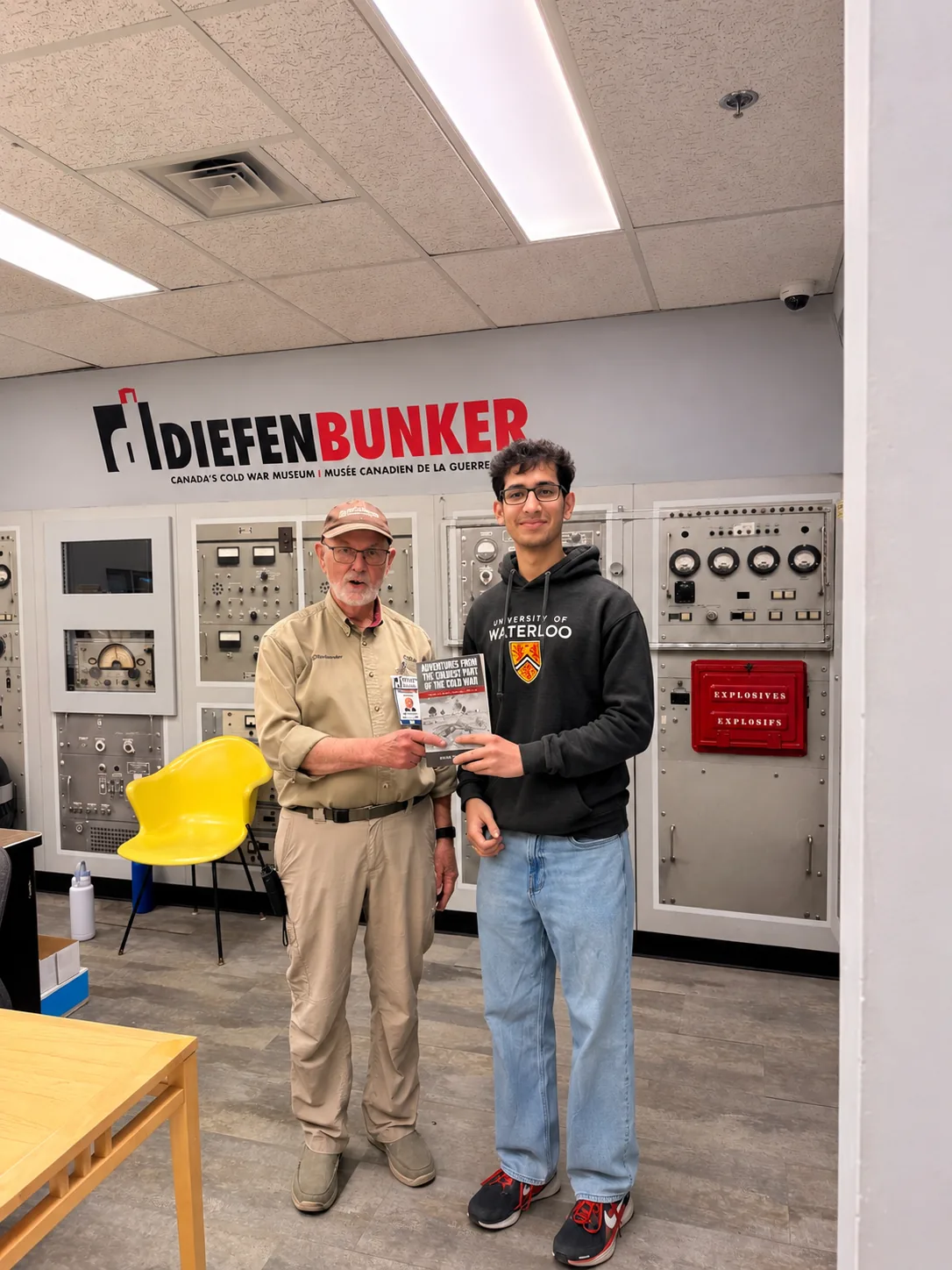
Today it’s run as Canada’s Cold War Museum, and a lot of the guides are volunteers who actually lived through it. While I was there, I met Brian, one of the volunteer guides who also turned out to be one of the warmest and most genuinely interesting people I’ve come across in a long time. Back in 1960 during the Cold War, at just 19, he became the youngest radar technician to have been sent north to work on the Distant Early Warning (DEW) Line. He even wrote a book about his time up there called Adventures from the Coldest Part of the Cold War. If you ever visit, look out for him, and definitely check out his book.
References
- George Brimmell. 78 bathrooms — and the Army still won’t admit that… This is the Diefenbunker. The Telegram (Toronto), 11 September 1961, p. 7. Photographs by Ted Grant.
- Wikipedia contributors. Diefenbunker. Wikipedia. Accessed November 2026.
- Bruce Ricketts. The Diefenbunker – Cold War Secret Defence Facility. Mysteries of Canada, 30 October 2014.
- Gilles Messier. That Time Toilets Gave Away a Cold War Secret. Today I Found Out, 26 October 2020.
- Leslie Hossack. Kennedy advises building of fallout shelters. Haute Vitrine, 9 December 2011.
- Daniel Coughlin. Inside the Diefenbunker: the secret Cold War bunker built to protect Canada’s elite. Love Exploring, 4 April 2024.
- Linda Aksomitis. Canada’s Little-Known Cold War Museum: the Diefenbunker. Guide2Museums, 21 August 2025.
- Don Butler. Amateur historian seeks ‘Holy Grail’ of Diefenbunker secrets. Ottawa Citizen, 4 February 2014.
- Allyson Gulliver. Shelter Fallout. Kayak: Canada’s History Magazine for Kids, no. 91, February 2025, pp. 16–19.
- Pat Sullivan. Tunnelling Back To The Cold War. Legion Magazine, 1 May 2006.
- Chris Ryall. The Diefenbunker and the Legends of Carp. Vacay.ca, 11 February 2021.
- Legion Magazine. Blast from the Past. Legion Magazine, 23 May 2024.
- Dave Kent. Museum Club Goes Deep: A Visit to the Diefenbunker. The Historical Society of Ottawa, 4 July 2025.
- Diefenbunker, Canada’s Cold War Museum. Meet the Honeywell DPS-6 minicomputer known as “Myrtle”. Placard on display at the museum, Carp, Ontario. Seen August 2026.
- Charles Trueheart. Debunking the Bunker. The Washington Post, 16 October 1995.