Mother-in-law languages
In some Aboriginal Australian communities, being in the vicinity of your mother-in-law meant changing the words you used.
In these communities, certain relationships came with rules about contact between relatives, including how people spoke in one another’s presence. A typical case was that of the relationship between a man and his mother-in-law, giving these special speech styles the name “mother-in-law languages”. These can be seen as a type of what's called avoidance speech wherein speakers of a language incorporate a distinctive style of speech dictated by particular social situations.
One well-documented example comes from Dyirbal, an Aboriginal Australian language of northeast Queensland. It belongs to the Pama–Nyungan family, whose languages were traditionally spoken across most of the Australian mainland.1
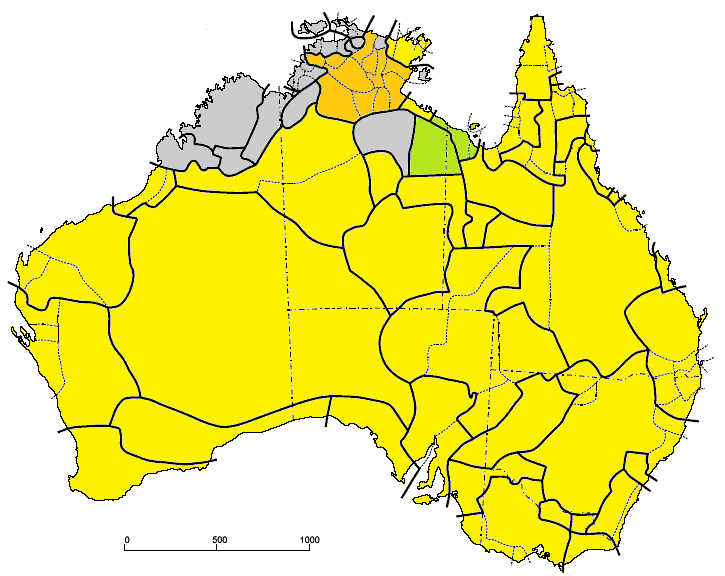
Pama–Nyungan languages Yellow marks Pama–Nyungan; the other colours mark other language groups. Map: Kwamikagami, public domain. Wikimedia Commons ↗

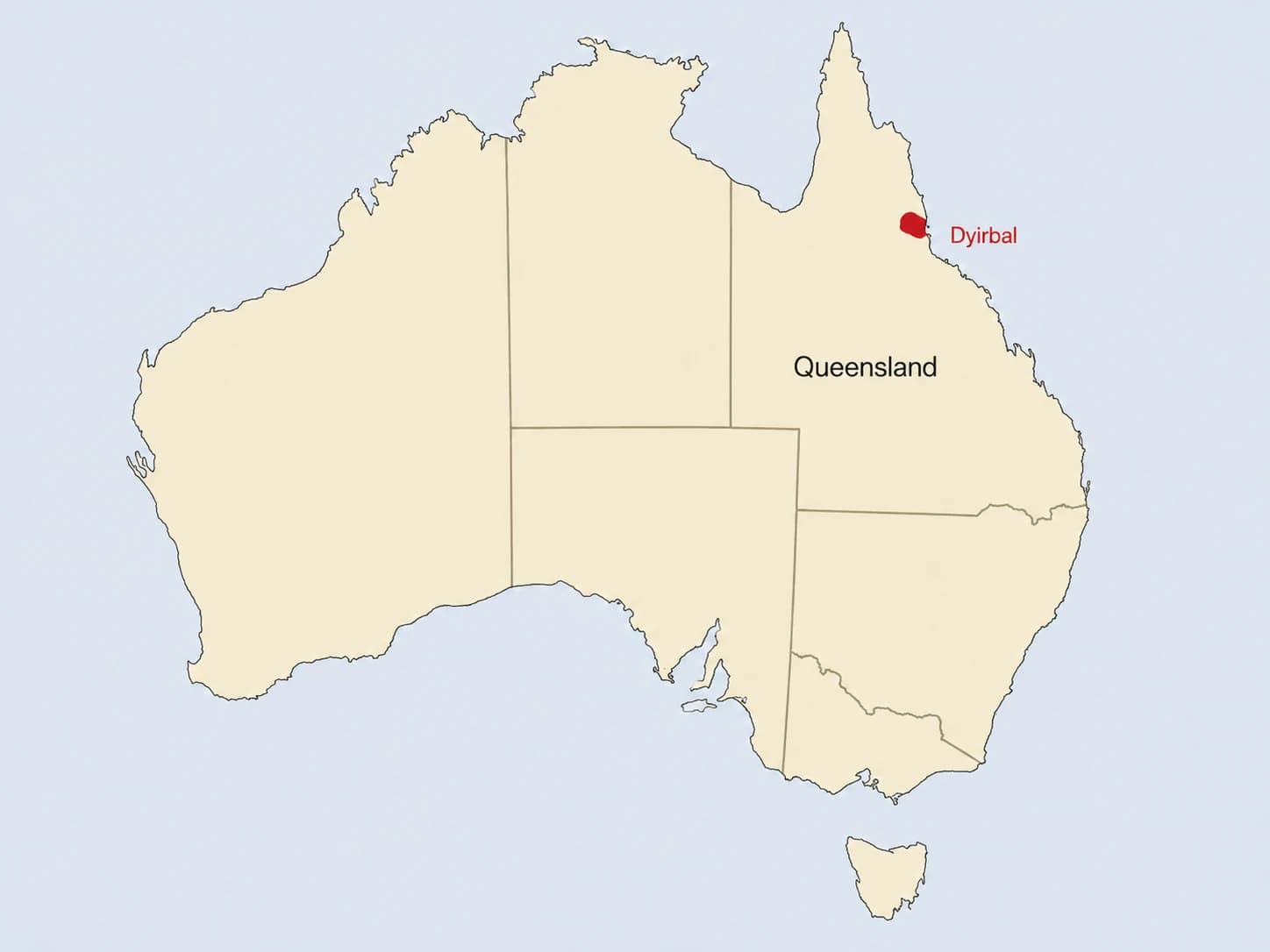
Dyirbal is also known for its four noun classes. Roughly speaking, these group together men and many animals; women, fire and water; edible plants; and a remaining category. There are plenty of exceptions, so these are only broad outlines of the system.2
Its avoidance register was called Jalnguy. The rules, for Dyirbal at least, covered more than mothers-in-law, as they also applied between a woman and her father-in-law, and between opposite-sex cross-cousins.3
When speakers switched to Jalnguy, the grammar stayed the same, but nearly all ordinary nouns, verbs and adjectives changed. Even words for things as basic as fire and water had replacements:
| Meaning | Everyday speech | Jalnguy |
|---|---|---|
| Fire | buni | yibay |
| Water | bana | jujamu |
Jalnguy also had a much smaller vocabulary. Everyday Dyirbal distinguished between head hair, a beard and a moustache with separate words; Jalnguy could use gumurray, a general word for hair, for all three. If someone needed to specify a moustache, they could add a description locating the hair on the upper lip.4
Sources
- Background on Pama–Nyungan
Catherine Sheard, Claire Bowern, Rikker Dockum & Fiona M. Jordan (2020). Pama–Nyungan grandparent systems change with grandchildren, but not cross-cousin terms or social norms. Evolutionary Human Sciences, 2, e30. Open-access article.
- Dyirbal’s noun classes
Keith Plaster & Maria Polinsky (2007). Women are not dangerous things: Gender and categorization. Harvard Working Papers in Linguistics, 12. Open-access paper, Harvard DASH.
- Kinship and avoidance speech
Luke Owles Fleming (2024). “Many to One: Lexicon Asymmetries in Avoidance Registers,” in On Speaking Terms: Avoidance Registers and the Sociolinguistics of Kinship, pp. 51–80. University of Toronto Press. JSTOR excerpt; full chapter may require access.
- Dixon’s account and examples
R. M. W. Dixon (2025). The Anatomy of Avoidance: A Full Study of Jalnguy, the Dyirbal ‘Mother-in-Law Language’. De Gruyter Mouton, printed pp. 1–3. Free PDF preview.